

When a company starts working with a recruitment agency, much of the work completed before the first CV arrives remains invisible.
The client shares a brief, the search begins and, after some time, candidates start appearing in the inbox, bu at Ahoy Career, the process between these two moments is considerably more structured.
Our recruitment model combines market research, performance marketing hiring, candidate qualification, recruitment technology and human assessment. The aim is to understand the candidate market around each role, reach relevant people efficiently and ensure that every candidate introduced to the client has already completed a clearly defined qualification process.
Here is what happens before we send a candidate to a client.
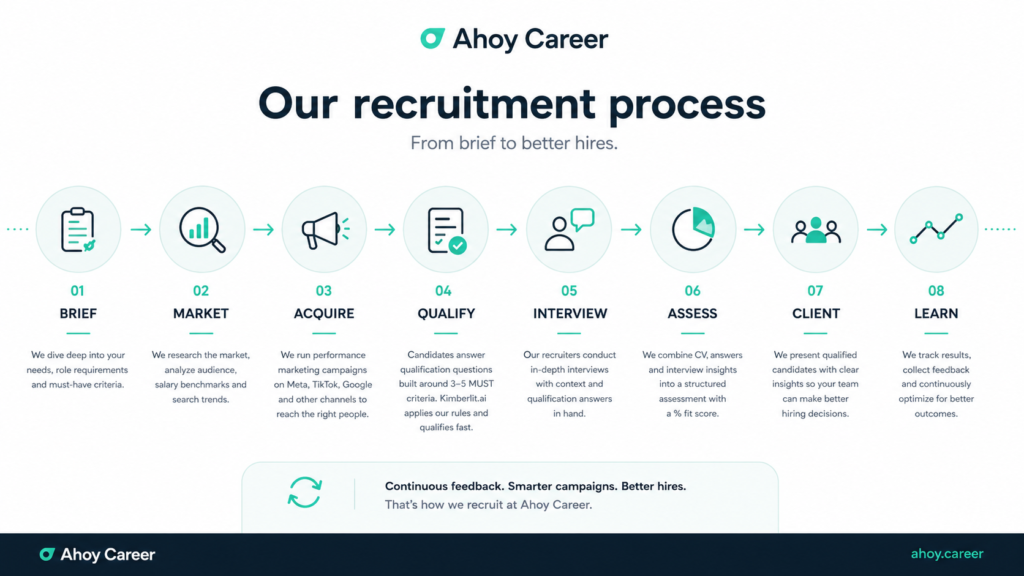
1. We start with the market, not the database
A recruitment brief explains what the company is looking for, but it does not automatically show us where the relevant candidates are, how large the reachable talent pool is or what might persuade them to consider the opportunity.
That is why we begin by analysing the market around the role.
Depending on the project, we review audience targeting options across platforms such as Meta and TikTok, Google search trends and search volumes, candidate locations and the digital behaviour of the audience we want to reach. This is particularly important in multilingual and international recruitment, where the location of the employer and the location of the relevant talent may be completely different.
A Dutch-speaking salesperson, a Czech customer service specialist and a Japanese-speaking accountant may all be considered multilingual hires, yet the appropriate channels, geography, messaging and candidate expectations can vary significantly.
Understanding the market gives us the foundation for deciding how the search should be conducted.
2. We turn the job description into a qualification model
A job description may include numerous requirements, responsibilities and preferences, although only a small number usually determines whether a candidate should move forward. Together with the client, we identify the criteria that are genuinely essential for the role. In most projects, this means defining approximately three to five MUST criteria.
They may relate to language proficiency, professional experience, location, availability, salary expectations, technical expertise or another factor that is critical to the search.
We then translate these requirements into qualification questions used in our candidate acquisition campaigns and qualification rules within Kimberlit.ai. This gives the recruitment process a clear and consistent starting point. Before our recruiters invest time in interviews, we already know whether a candidate meets the fundamental requirements agreed with the client.
3. We create candidate demand instead of relying only on existing databases
Performance marketing hiring is part of our standard recruitment delivery.
Traditional recruitment methods remain valuable where they are appropriate, although we do not want the success of a search to depend solely on people browsing job boards, appearing in an existing database or responding to direct sourcing. Instead, we build campaigns around the audience relevant to the specific role.
This involves selecting channels and targeting based on where the candidates are likely to be found, adapting the communication to their expectations and incorporating qualification directly into the candidate acquisition process. As a result, we can reach a broader part of the talent market, including people who may be open to a career move without actively searching job boards every day.
The media investment required for this candidate acquisition is funded by Ahoy Career as part of the recruitment project and comes from the prepayment agreed with the client, and this is also one of the reasons our cooperation model includes commitment from both sides from the beginning.
4. Kimberlit.ai helps us respond and qualify efficiently
Generating candidate interest is valuable only when the recruitment process can respond while that interest is still active.
We use Kimberlit.ai within our recruitment workflow to support qualification, candidate communication and progression through the early stages of the process. Candidates answer questions based on the client’s MUST criteria, while predefined rules help determine who should move forward.
A qualified candidate can then be directed towards a conversation with our recruiter without unnecessary delays between the initial campaign interaction and human contact. This connection between candidate acquisition and candidate experience is essential. A campaign may generate strong interest, but if the recruitment process responds too slowly, that interest can disappear before the first meaningful conversation takes place.
5. Our recruiter enters the conversation with context
When a candidate reaches an Ahoy Career recruiter, the conversation begins with relevant information already available.
The recruiter has access to the candidate’s profile and qualification answers, as well as confirmation that the person meets the basic criteria agreed for the project. This allows the interview to focus on the areas that require human judgement.
The recruiter can explore the candidate’s experience in context, understand their motivation for considering a change, clarify expectations and identify strengths or potential concerns that would be difficult to assess through a CV or qualification form alone.
The conversation also helps us determine whether the opportunity is genuinely suitable for the candidate, rather than assessing only whether the candidate appears suitable for the employer. Long-term recruitment quality depends on both sides of that match.
6. We assess the candidate against the actual brief
After the recruiter interview, we combine three main sources of information:
the candidate’s CV, qualification answers and recruitment conversation.
Our team uses structured internal workflows within secure paid LLM environments to organise and compare this information consistently. The technology supports the process, while the recruiter remains responsible for the assessment and the context behind it.
The client receives the candidate’s profile together with our percentage fit assessment against the agreed requirements. This includes the areas where we see the strongest alignment, as well as any potential gaps or points that should be explored further.
The percentage is not intended to reduce a person to a score, bu it gives the client’s recruitment team a clear and efficient way to understand why the candidate has been presented and how our assessment relates to the brief agreed at the beginning of the project.
7. The client receives a qualified candidate, not simply another CV
By the time we introduce a candidate, several stages of the process have already been completed.
We have analysed the market, built the acquisition approach, reached the candidate, checked the agreed MUST criteria, collected qualification information, conducted a recruitment conversation and assessed the profile against the client’s requirements. For the client’s recruitment team, this means that a significant part of candidate discovery and first-stage qualification has already been completed.
Their time can then be focused on the next important question:
Is this someone we actually want to hire?
That distinction matters to us. A large number of CVs may create activity, while candidates who have completed a defined acquisition and qualification process create a more meaningful recruitment pipeline.
8. The market continues to give us information after the campaign starts
A recruitment brief remains a set of assumptions until real candidates respond to it.
As a campaign progresses, we can see which audiences engage, where candidates are located, which messages generate interest, how many people meet the qualification criteria and where candidates leave the process. Our recruiters also receive direct feedback about compensation, location, expectations, competing opportunities and the reasons candidates decide not to continue.
We bring these signals together through market feedback, salary feedback, candidate feedback and regular reporting.
When the data shows that the original assumptions are limiting the search, we review the situation with the client and recommend the changes that could improve the outcome. This may involve compensation, geography, requirements or recruitment communication.
The final decision remains with the client, while our responsibility is to make the real market visible and provide the evidence needed to make an informed decision.
Recruitment delivery has changed
Recruitment agencies have traditionally created value through access to databases, sourcing expertise and recruiter networks.
These capabilities remain important, although the candidate market is now much larger than the group of people actively browsing vacancies or visible within a single recruitment platform. That is why Ahoy Career combines recruitment delivery with performance marketing hiring and technology.
We want to understand where the relevant candidate market is, build an effective way to reach it, qualify interest efficiently and give our recruiters better information before they begin the human part of the process. This creates a more complete approach to agency recruitment.
The work begins with understanding the market and continues until the client has enough relevant information to make a confident hiring decision.